
Frontier Firms: The Technical Reality Behind Microsoft’s Vision
The Data Massagist From messy data to measurable outcomes—governed platforms that power agentic AI.

Frontier Firms: The Technical Reality Behind Microsoft’s Vision
Created on 2026-05-27 16:01
Published on 2026-05-27 21:13
Welcome to Edition #12 of The Data Massagist.
This edition is dedicated to the more than 3,200 subscribers who take the time every two weeks to read this newsletter—and especially to the 100+ of you who continuously send feedback, ideas, and thoughtful perspectives for future editions. Your comments, discussions, and challenges are shaping this journey as much as the writing itself.
In the previous edition, I wrote about the importance of building AI agents that can consume, collaborate with, and orchestrate other agents as a way to accelerate AI adoption across organizations.
I shared the three agent patterns I consistently see emerging in enterprise implementations:
Triage Agent — Intelligent intake and prioritization. Agents that understand requests, classify intent, and determine urgency or business impact.
Router Agent — Dynamic task delegation. Agents that coordinate actions, distribute workloads, and connect workflows across systems and teams.
Orchestrator Agent — Workflow coordination and execution. Agents capable of managing multi-step business processes with increasing levels of autonomy.
Today, I want to continue that conversation by trying to explain, from a technical and engineering perspective, what Microsoft means when it talks about a Frontier Firm.
This is especially relevant for Chief Data Officers (CDOs), data engineers, architects, and Solution Engineers like me who are trying to understand how AI is fundamentally changing enterprise architecture.
Most organizations still think AI is about helping employees work faster. But that’s not the real transformation.
The real shift is this:
AI is moving from assistant… to executor. And that changes enterprise architecture entirely.
For me, a Frontier Firm is a company redesigning its operating model around AI-driven execution.
From Personal Shift to Industry Shift
Over the last year, Microsoft’s transformation pushed me into one of the biggest pivots of my career: moving from an M2 leadership role into a deeply technical Principal Solution Engineer position focused on the Data Platform.
One decision changed everything:
I chose to embrace AI as deeply as possible.
Today, I orchestrate between 10 and 15 AI agents as part of my daily work. Some are provided by my organization—such as Researcher, Copilot for Sales, Writing Coach, Know Your Customer, and Employee Self-Service—while others have become personal favorites, including Prompt Coach and GitHub Copilot.
I do not use these agents as demos or experiments. I use them as part of my operational workflow and as a way to amplify more than 30 years of experience across multiple roles, industries, and leadership responsibilities.
That experience has given me a front-row seat to what Frontier Firms will eventually become.
Today, I operate as what I call an Agent Boss: someone who orchestrates AI agents the same way leaders traditionally orchestrated teams.
I no longer spend most of my time only searching for answers. Instead, I focus on building hypotheses, testing ideas faster, and transforming concepts into operational reality.
More importantly, I now have more time to think about what truly matters:
how to maximize business value,
how to optimize performance,
and how to balance innovation with cost.
Because while AI can produce extraordinary outcomes, not every outcome is economically viable at enterprise scale.
This is no longer science fiction. It is the early operational model of the AI-native enterprise.
You can read more in the article: A New Dimension in My Career and Life.
The Most Important Shift
In traditional enterprises, software supported human execution. In Frontier Firms, AI becomes the execution layer itself.
That changes how systems are designed, how workflows operate, how decisions are made, and ultimately how organizations scale.
From a technical perspective, a Frontier Firm is:
A distributed system composed of humans, AI agents, data platforms, and workflows—where AI is not a feature, but the execution layer of the business.
Over the last 24 months, enterprise architecture has started to evolve rapidly.
Traditional environments were built around systems of record, static workflows, and human-driven execution. The flow looked like this:
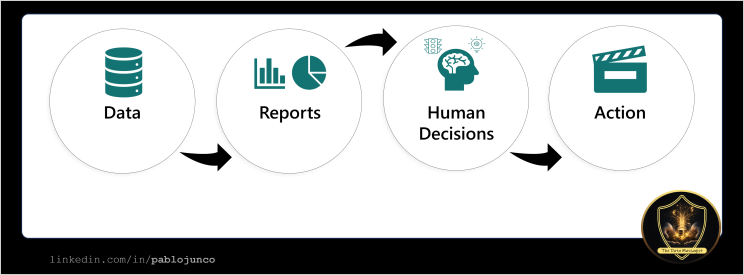
Frontier Firms operate differently:
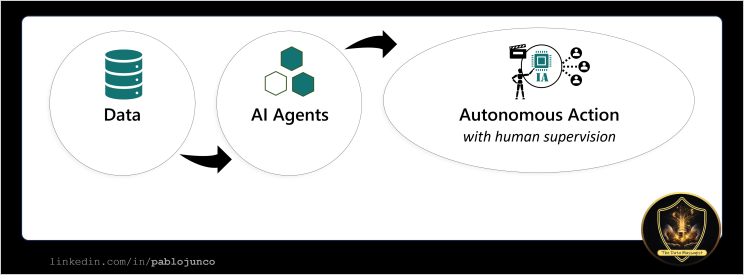
This is not simply automation.
It is the transition from software that informs humans… to systems that can reason, decide, and execute.
Why This Matters Now
For the last decade, enterprises optimized visibility. The next decade will optimize autonomous execution.
That is why nearly every executive conversation today revolves around revenue acceleration, operational efficiency, workforce productivity, and AI operationalization.
The winners will not be the organizations with the most AI demos and Proof of Concepts (PoC) hidden being innovation related initiatives.
They will be the companies that operationalize AI safely at scale. And the answer is not more dashboards.
It is AI-native execution.
Imagine a supply chain workflow a few years ago. Analysts reviewed dashboards, identified anomalies, opened tickets, escalated issues, and coordinated actions manually.
Now imagine AI agents continuously monitoring telemetry in real time, detecting anomalies, triggering workflows, generating remediation plans, and escalating to humans only when approval is required.
That is the operational difference between a traditional organization and a Frontier Firm.
This is the mindset: humans should focus on defining clear goals, setting direction, and providing oversight, while AI agents should support building, executing, evaluating, and generating summaries and recommended actions—all at scale.
From Vision To An Enterprise Platform
To operationalize the Frontier Firm vision at scale, Microsoft is building an integrated agentic platform where intelligence, trust, governance, and orchestration are embedded directly into the enterprise architecture.
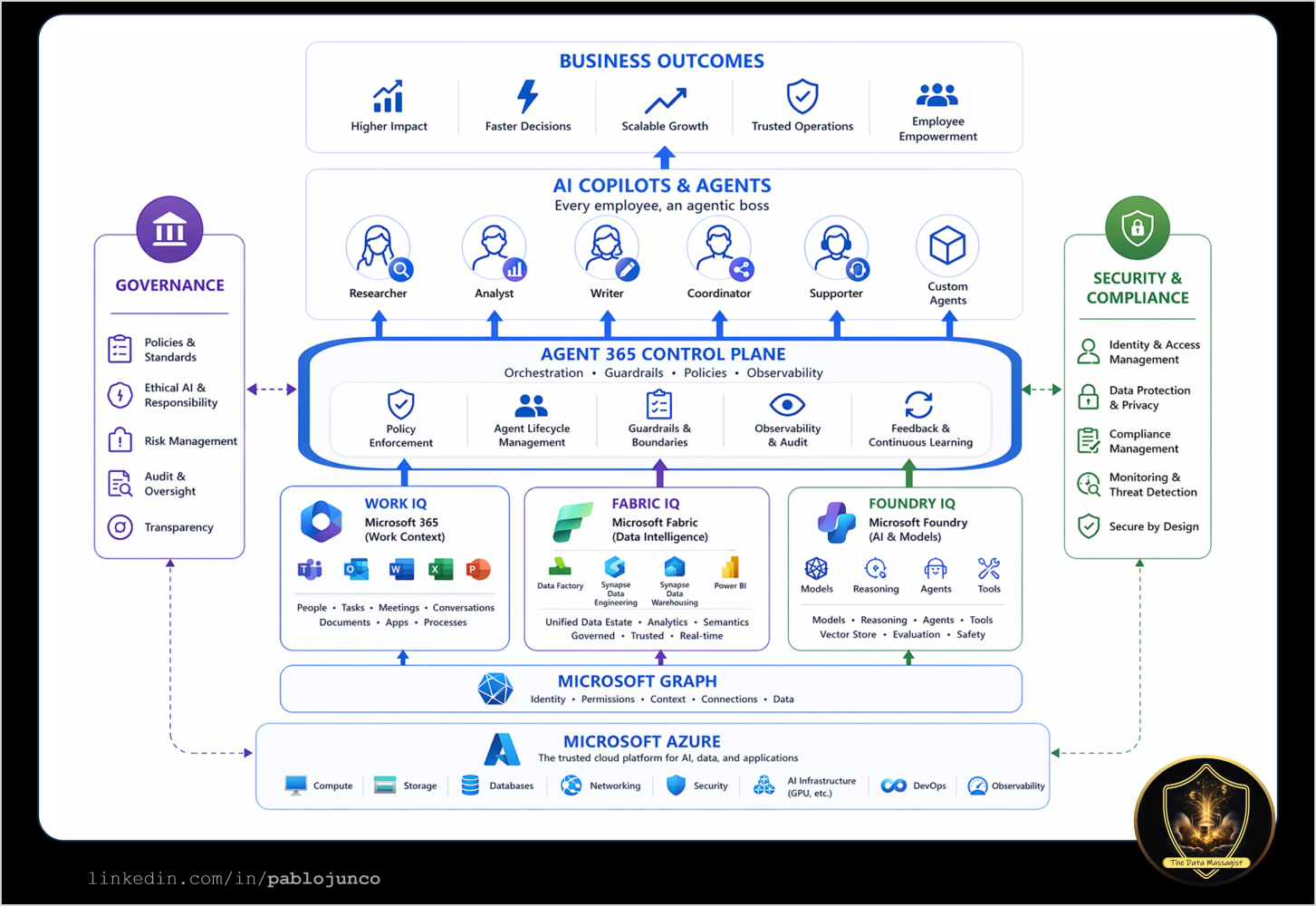
In the image below I'm trying to represent how all the layers work together to support a new execution model—one where AI agents are not isolated assistants, but distributed operational components participating in business workflows across the organization.
At the infrastructure layer, Microsoft Azure provides the foundational services required to run enterprise-grade AI systems:
elastic compute,
GPU acceleration,
distributed storage,
networking,
identity,
observability,
and security services.
This layer enables organizations to deploy and scale AI workloads while maintaining reliability, resiliency, and operational control.
Above the infrastructure layer sits Microsoft Graph, which acts as the organizational context engine for the platform. This is a critical architectural component. AI agents require more than data access. They need contextual understanding of:
users,
relationships,
meetings,
conversations,
documents,
permissions,
workflows,
and collaboration patterns.
Microsoft Graph provides this real-time semantic context while respecting enterprise identity boundaries and permission models. This allows agents to reason and act securely on behalf of users without bypassing organizational governance controls.
The platform is then powered by three complementary intelligence layers.
1) Work IQ — Human and organizational context. This layer captures operational signals across Microsoft 365 including meetings, chats, emails, tasks, calendars, and collaboration behaviors. It enables AI systems to understand how the workflows across teams, projects, and business functions.
2) Fabric IQ — Enterprise data intelligence. This layer provides the governed data foundation required for enterprise-scale AI reasoning. Through Microsoft Fabric, organizations unify structured and unstructured data, semantic models, analytics, real-time telemetry, and business context into a single operational intelligence layer. This reduces fragmentation and improves consistency across AI-driven decisions.
3) Foundry IQ — AI orchestration and reasoning. This layer enables the creation, deployment, and coordination of AI agents and multi-agent systems. It includes:
model orchestration,
prompt engineering frameworks,
memory management,
reasoning engines,
workflow execution,
and agent-to-agent collaboration patterns.
This is also where platforms like Microsoft Foundry and Copilot Studio become strategically important.
Microsoft Foundry provides the engineering environment for building, evaluating, grounding, and orchestrating enterprise AI systems at scale. In my view, it has the potential to significantly accelerate agent creation by unifying intelligence across tools such as Databricks Genie, Fabric Data Agents, and enterprise APIs. This enables agents to reason over distributed data sources, operate on governed enterprise information, and orchestrate real business workflows—while maintaining centralized controls for safety, consistency, performance, and cost management.
Microsoft Copilot Studio (MCS), on the other hand, operationalizes this capability for the enterprise. It empowers organizations to create, customize, extend, and govern AI agents that are directly connected to enterprise workflows, APIs, Microsoft 365, Microsoft Fabric Data Agent, Fabric IQ, Dataverse, and external systems. In this sense, Copilot Studio acts as a practical bridge between business users, enterprise processes, and the underlying AI orchestration and agentic platform.
Importantly, this is not an either-or decision.
Microsoft Foundry and Copilot Studio serve different layers and different audiences within the same architecture. One focuses on engineering depth and system-level orchestration, while the other focuses on business enablement and rapid agent adoption. Both are complementary, and in many enterprise scenarios, they will coexist and reinforce each other. There is no “one-size-fits-all” approach to agent development—different use cases, teams, and maturity levels will naturally require different entry points into the platform.
The real opportunity is not choosing one over the other, but leveraging both in a coherent way to scale AI adoption across the organization while maintaining governance, security, and cost discipline.
This is critical for Frontier Firms because AI adoption will not scale through centralized engineering teams alone.
Eventually, every department will build, customize, and orchestrate its own agents.
Above these intelligence layers sits what Microsoft increasingly positions as the Agent Control Plane. From an engineering perspective, this becomes one of the most important layers in the architecture.
The Agent Control Plane is responsible for:
agent lifecycle management,
policy enforcement,
identity propagation,
observability,
auditability,
telemetry,
security boundaries,
compliance enforcement,
and runtime governance.
As enterprises scale from dozens to potentially thousands of AI agents, centralized operational visibility and governance become essential. Without this layer, organizations risk uncontrolled agent sprawl, inconsistent behaviors, duplicated workloads, and significant security exposure.
Finally, AI Copilots and Agents become the user interaction and execution layer. This is where employees interact with AI systems directly inside business workflows through Microsoft 365, business applications, APIs, and custom enterprise experiences.
From a systems architecture perspective, the result is the emergence of a new enterprise execution model:
humans provide supervision,
agents provide execution,
data provides context,
and governance provides trust.
The outcome is not simply improved productivity. It is a distributed intelligent system capable of delivering:
faster operational decisions,
adaptive workflows,
scalable execution,
lower operational friction,
and continuous optimization across the enterprise.
Most importantly, governance, security, and compliance are not isolated capabilities added later. They are embedded across the entire platform stack by design.
Because in a Frontier Firm, trust is not an external control mechanism. It is part of the runtime architecture itself.
The Role Of Microsoft Fabric
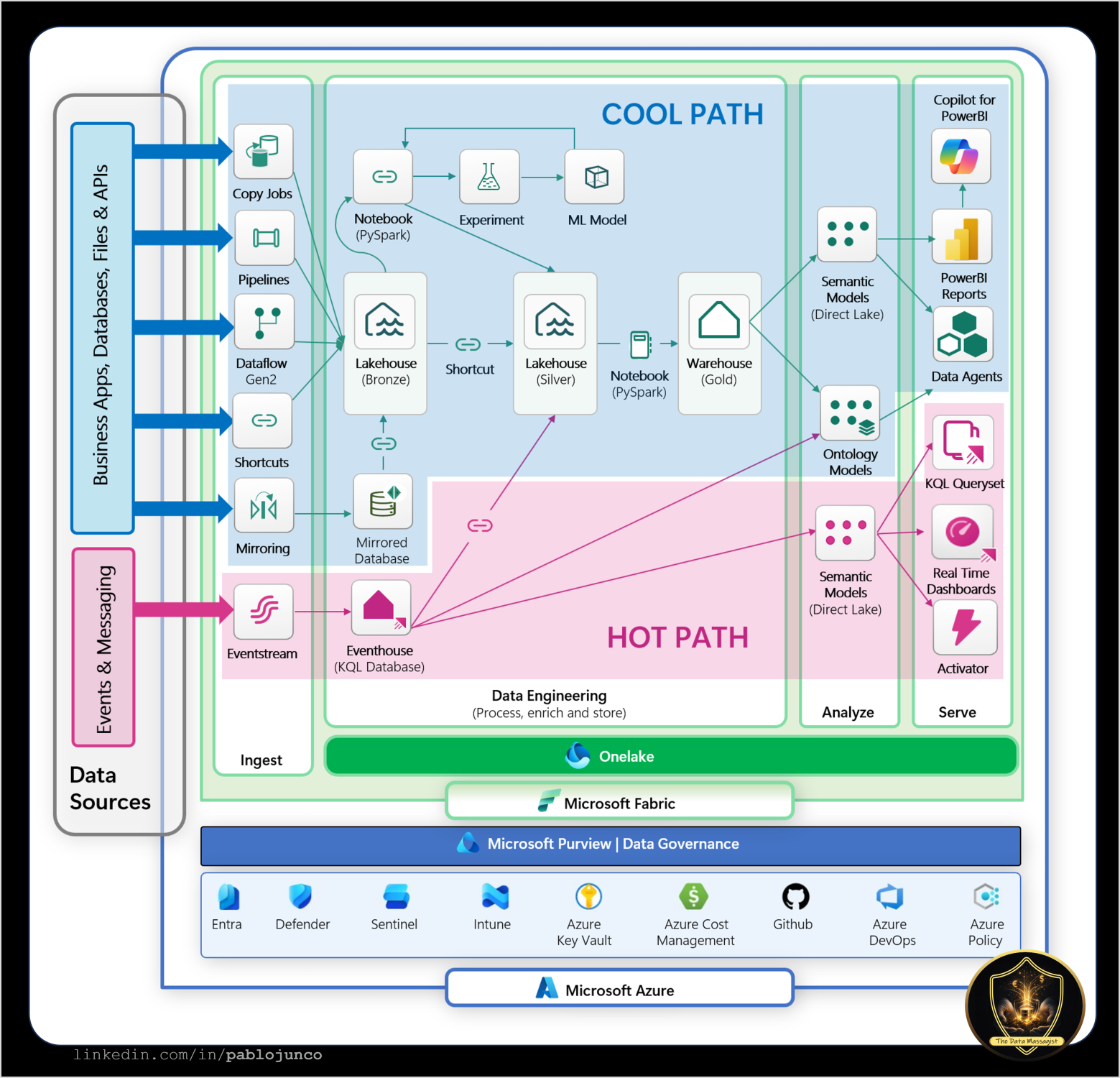
Since The Data Massagist is ultimately about turning data into insight and action, I want to close with one of the platforms I believe will play a critical role in this transformation: Microsoft Fabric.
In many ways, Fabric becomes the data foundation for Frontier Firms.
Unified data foundation — AI requires consistent and governed context. Fabric helps eliminate silos and creates a trusted enterprise source of truth for AI reasoning.
AI-ready architecture — Data moves closer to operational execution. Real-time contextualized data and native AI integration accelerate the transition from experimentation to production.
Insight-to-action acceleration — Complexity becomes the enemy of scale. Fabric simplifies how organizations connect data, analytics, and AI-driven workflows across the enterprise.
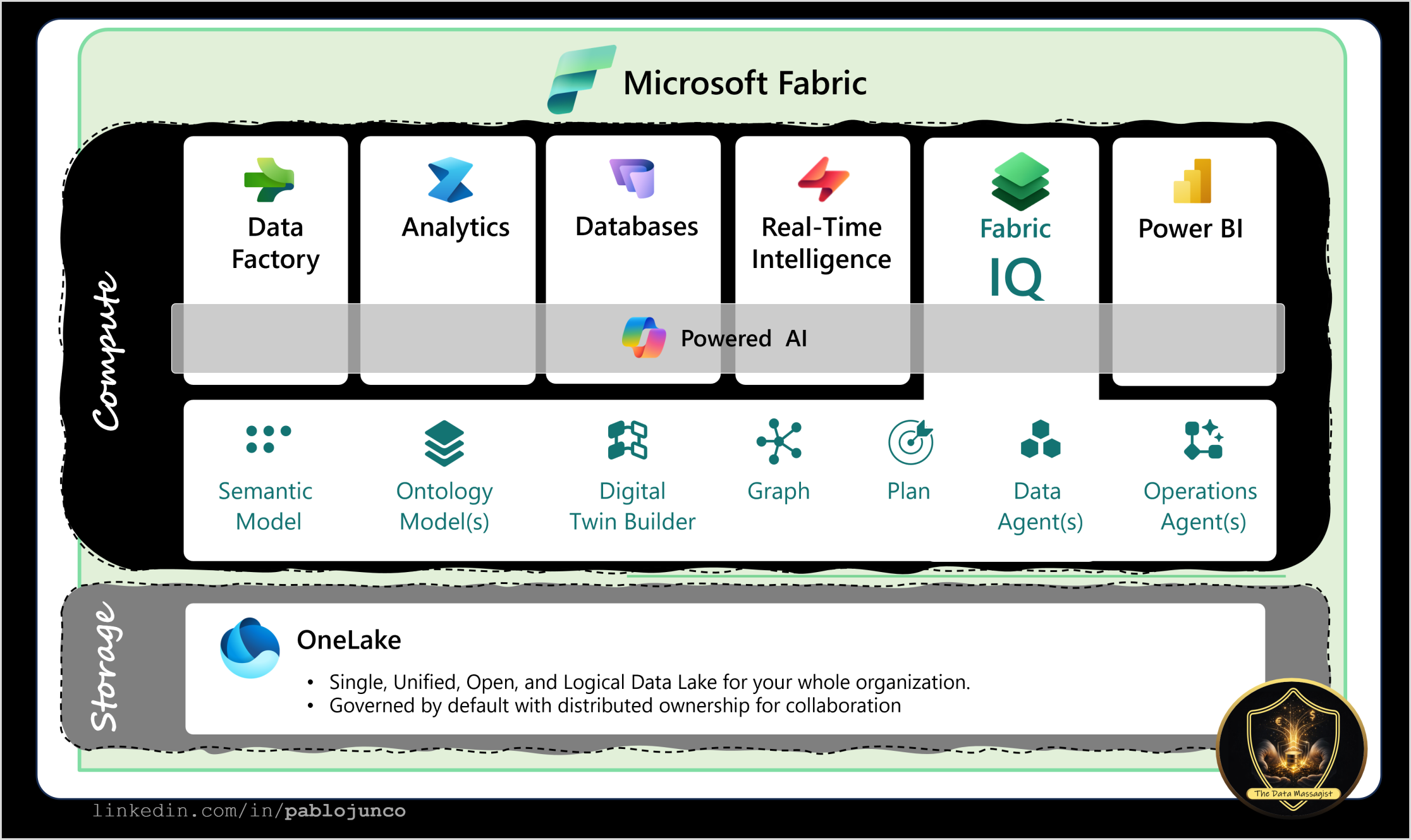
Microsoft Fabric now introduces additional engine called Fabric IQ—a semantic and operational intelligence layer that transforms unified data into AI-ready, agent-consumable knowledge.
Semantic and contextual intelligence — AI requires meaning, not just data. Fabric IQ provides governed semantic models and business context, allowing agents to reason consistently across domains and align with enterprise definitions.
Operational data layer — Data must be actionable, not static. Fabric IQ bridges analytics and execution, enabling agents to move from insight to action by integrating directly with workflows and business processes.
Real-time intelligence — Decisions must happen at the speed of the business. With Fabric RTI, organizations can integrate events, CDC, and logs into agent workflows—making AI responsive, adaptive, and context-aware in real time.
Composable intelligence components — Scale requires modularity. Fabric IQ is powered by key building blocks such as Ontology Models, Maps, Data Agents, and Operations Agents, enabling consistent semantics, connected context, and executable intelligence across the enterprise.
The future is not simply about having more data. It is about turning data into trusted, intelligent, and increasingly autonomous action.
Please, read this article to learn more about Microsoft Fabric in the context of a Well Architected Framework.
Final Thought
The next generation of enterprise leaders will not compete on access to AI.
Everyone will have AI.
The real differentiator will be who can operationalize intelligence faster, safer, and at scale.
Frontier Firms are not deploying AI as another feature.
They are redesigning how work itself gets executed.
And platforms like Microsoft Fabric and Microsoft 365 Agent will become the operational foundation that makes that future possible.
Until next edition,

